

Rethinking Construction Materials
Three Constraints, One Material: How FAIRMAT Is Rethinking Construction Materials
In an industry long driven by price and performance, carbon impact has become an obligation rather than a differentiator. A recent example is the EU Directive 2024/1275, which phases in life-cycle carbon disclosure for new buildings¹.
These objectives are difficult to reconcile, especially in an industry where production lines are complex and costly to modify. New materials must also be available in industrial volumes from day one, first for qualification, then for mass production.
This calls for new materials capable of delivering on performance, cost, and environmental impact at the same time, while integrating seamlessly into existing production processes and being available at industrial scale.
“We chose to work with FAIRMAT for their ability to deliver composite materials that are both highly performant and significantly less impactful environmentally, while remaining compatible with industrial construction requirements. This collaboration allows us to explore new sustainable, credible, and scalable solutions.”
Eric Bertrand, Chief Innovation Officer of ETEX
How FAIRMAT Reconciles Performance, Cost, and Sustainability
FAIRMAT was built to meet all of these requirements at once. The company has developed a recycling technology, based on robotics and AI, to preserve the characteristics of high-end carbon fiber composite waste, turning aerospace and wind energy scrap into high-performance materials.
The combination of recovered feedstock and automated production keeps costs low, enabling FAIRMAT to match the price of the materials it replaces. For manufacturers, this also means a secure and scalable supply. With 3,000 tonnes of contracted feedstock, FAIRMAT can support long-term programs without depending on a single waste stream. Its three recycling and production sites in France, the United States, and China deliver industrial volumes from qualification through to mass production for leading automotive, sporting goods, and construction companies.
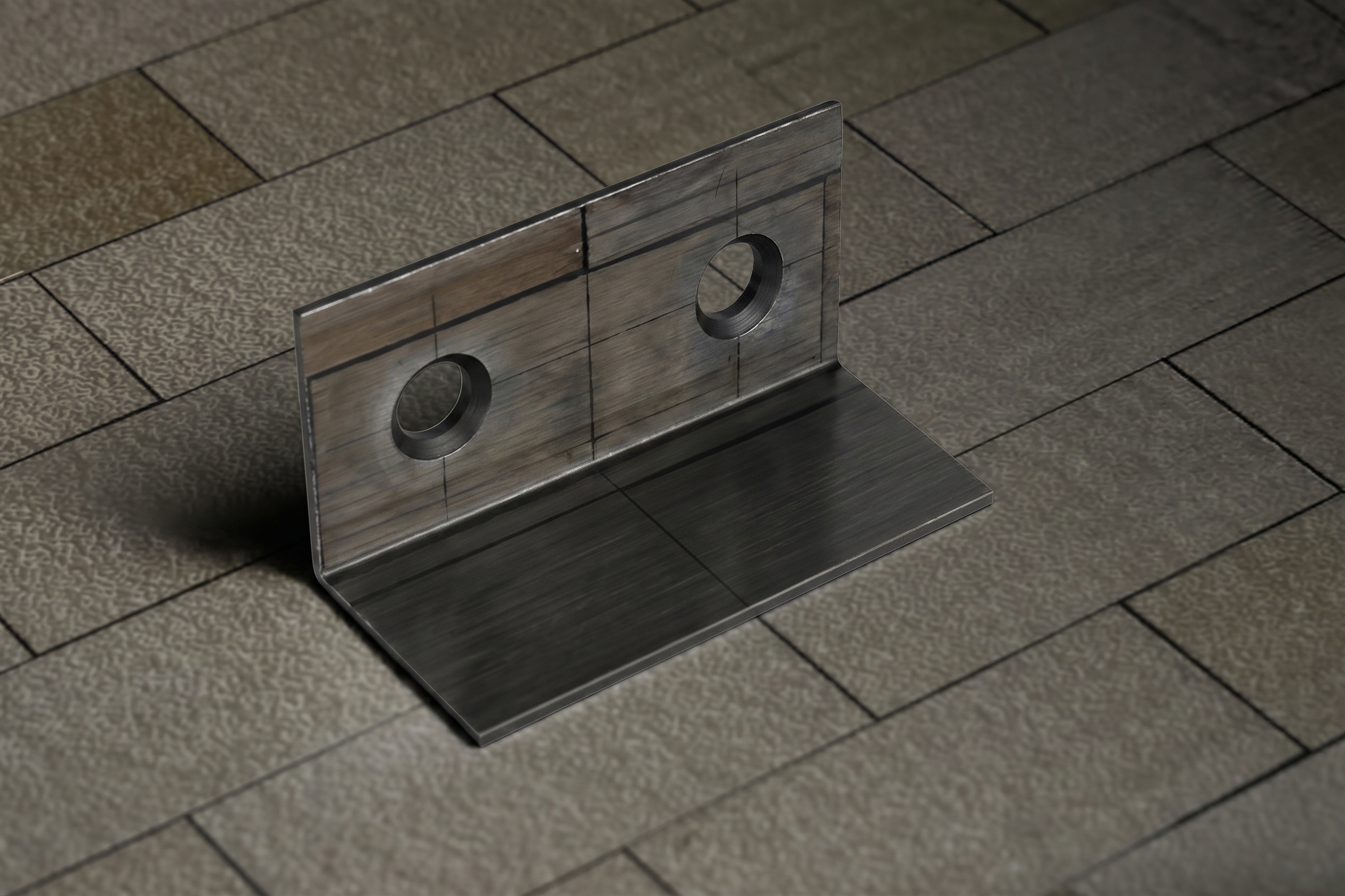
Mounting Systems, Fastening Hardware, Rails & studs
Brackets, rails, angle bars, and connectors are a natural entry point for FAIRMAT materials, starting with their durability. Because carbon fiber composite does not rust, the parts hold up in humid, coastal, or alpine environments without any anti-corrosion treatment. They are also five times less thermally conductive than steel, which helps limit thermal bridging in insulated facades.
This durability comes at price and performance parity with the metal parts they replace. Thanks to their high stiffness-to-weight ratio, FAIRMAT parts carry the same loads with less material. At equal design, they are up to 82% lighter than zinc-coated steel, simplifying transport, handling, and installation. On top of that, their CO₂ emissions are 97% lower than those of standard steel and 23% lower than those of low-carbon steel³

Core material for Panels, Façade and furniture
FAIRMAT materials are also available in large board formats, as an alternative or a complement to sturdy or structural cores such as HPL and compact laminates for demanding applications.
Thanks to a high stiffness-to-weight ratio (bending modulus of 120 GPa at a density of 1.6 g/cm³ along the fiber direction), they meet or exceed the performance of the incumbent cores at the same or lower cost in the use cases assessed so far. Carbon fiber composites also offer low dimensional change in humid conditions, making them a good fit for outdoor, kitchen, and bathroom panels.
Made from up to 95% recycled material and based on epoxy rather than phenolic resin, FAIRMAT materials also lower the environmental impact of our customers’ products.
Making the Switch to FAIRMAT Carbon
Switching to FAIRMAT does not mean rebuilding a production line: FAIRMAT supplies finished or semi-finished parts, or the material itself as plies or boards, for the manufacturer or its OEM to process.
When selecting materials to be processed, whether plies or boards, FAIRMAT materials can be integrated into existing lay-ups for molding or lamination, or cut to shape with CNC machining. When required, the manufacturer’s decorative layers are bonded to the FAIRMAT material with adhesives, so the final product keeps the look and feel its customers know. FAIRMAT materials can also be combined with incumbent materials in hybrid lay-ups, so that each part reaches its specific target specifications or properties. Those transitions take place within existing operations, with no additional capital investment.
FAIRMAT Carbon addresses several production challenges with a single material: higher performance and a lower carbon footprint, at the price of the materials it replaces. It is available at industrial scale and integrates seamlessly into existing production lines.
Curious how FAIRMAT materials perform in your application? Contact our team.
contact@fairmat.tech | fairmat.tech
References
1. EUROPEAN PARLIAMENT AND COUNCIL OF THE EUROPEAN UNION. Directive (EU) 2024/1275 of the European Parliament and of the Council of 24 April 2024 on the energy performance of buildings (recast). Official Journal of the European Union, L series, 8 May 2024. Article 7.
2. MASON, Hannah. Plant tour: Fairmat FairFactory, Nantes, France. CompositesWorld, 1 June 2026.
3. FAIRMAT SAS. FairPly / FairPatch vs. Steel DX51D: Product Comparison and Life Cycle Assessment. Internal document. Paris: FAIRMAT SAS, 2026.
4. FAIRMAT SAS. Internal cost data. Paris: FAIRMAT SAS, 2026.
5. FAIRMAT SAS. FairBoard & FairSlat Material Data Sheet. Ref. FMT-PDT-EXT-0004. Paris: FAIRMAT SAS, June 2026.
6. INTERNATIONAL AGENCY FOR RESEARCH ON CANCER. Chemical Agents and Related Occupations. IARC Monographs on the Evaluation of Carcinogenic Risks to Humans, Volume 100F. Lyon: IARC, 2012.
7. FAIRMAT SAS. Internal technical data. Paris: FAIRMAT SAS, 2026.
